Basic Concepts of Probability
Section 5.1Probability Experiment
A probability experiment is one where we cannot predict the outcome of a single trial, but we can anticipate the overall pattern after many repetitions.
Drag the slider to change the number of repetitions.
When flipping a fair coin, a single toss is uncertain, but over many tosses, about half will be heads and half tails. The probability of an event is the long-term proportion of times it occurs. For a fair coin, the probability of heads is .
The Law of Large Numbers states that as a probability experiment is repeated many times, the proportion of occurrences of a given event will get closer to its expected probability.
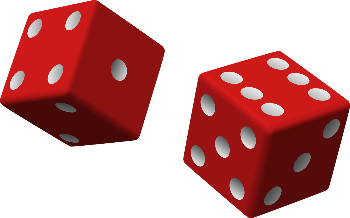
Sample Space
Two ways to find a probability run through this section: counting outcomes when they are equally likely, and estimating from data when they are not. Counting starts with a list of everything that could happen.
The collection of all the possible outcomes of a probability experiment is called a sample space.
Example:A coin is tossed
Sample space: {Heads, Tails}
A student is selected at random from a list of 10,000 at a university
Sample space: The collection of the 10,000 students
A simple random sample of 100 people is selected from a list of 10,000 subscribers to a YouTube channel
Sample space: Every group of 100 people that can possibly be chosen
 Definition
Events
We often focus on events that include several outcomes. For example, when rolling a die, the probability of rolling an odd number involves the outcomes {1, 3, 5} from the sample space {1, 2, 3, 4, 5, 6}. A collection of outcomes from a sample space is called an event.
Probabilities for events are denoted by . For instance, the probability of a coin landing heads is . More generally, if is an event, its probability is written as .
The probability of an event is always between 0 and 1 (inclusive).
If cannot occur, then .
If is certain to occur, then .
Probabilities with Equally Likely Outcomes
This is the case where a probability is easiest to compute: outcomes that are all equally likely.
If a sample space has equally likely outcomes and an event has outcomes, then

In the Georgia Cash-4 Lottery, a winning number between 0000 and 9999 is chosen at random, with all the possible numbers being equally likely. What is the probability that all four digits are the same?
The outcomes in the sample space are the numbers from 0000 to 9999, so there are 10,000 equally likely outcomes in the sample space.
= 10,000There are 10 outcomes for which all the digits are the same: 0000, 1111, 2222, and so on up to 9999.
= 10 Example
Probabilities with Equally Likely Outcomes
A penny, a nickel, and a dime are tossed. There are eight possible outcomes: HHH, HHT, HTH, HTT, THH, THT, TTH, and TTT. Assume these outcomes are equally likely.
Each column is one outcome: penny, nickel, dime, top to bottom.What is the probability that all three tosses are the same?
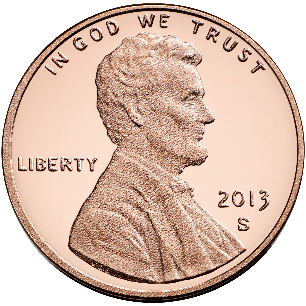


Solution: Of the eight equally likely outcomes, the two outcomes HHH and TTT correspond to having all tosses the same. Therefore,
ExampleProbabilities with Equally Likely Outcomes
A penny, a nickel, and a dime are tossed. There are eight possible outcomes: HHH, HHT, HTH, HTT, THH, THT, TTH, and TTT. Assume these outcomes are equally likely.
Each column is one outcome: penny, nickel, dime, top to bottom.Suppose that we know that the penny lands tails. What is the probability of getting more tails than heads?
Solution: If we know that the penny lands tails, then the sample space is: THH, THT, TTH, and TTT.
Three of these four outcomes correspond to “more tails than heads” so:


Which planet in our solar system takes longest to rotate once on its axis?
Three rounds of a game show. The questions aren't the point — the probability is.
If you simply guess, what is the probability you guess correctly?
The four options are equally likely to a guesser, so .
Which of these lakes holds the greatest depth of any lake on Earth?
After the 50:50, two options remain, so .
Which of these summits sits farthest from the center of the Earth?
Expert rules out one wrong answer, so three options remain and .
The event stayed the same every time; what moved was the sample space.
Example: Sampling as a Probability Experiment
Here the experiment is a piece of sampling: one family is chosen at random from the ten thousand.
There are 10,000 families in a certain town categorized as follows:
| Own a house | Own a condo | Rent a house | Rent an apartment |
|---|---|---|---|
| 4753 | 1478 | 912 | 2857 |
A pollster samples a single family from this population.
What is the probability that the sampled family owns a house?
The sample space consists of 10,000 households. Of these, 4753 own a house. Therefore,
What is the probability that the sampled family rents?
The number of families who rent is . Therefore,
 Definition
Empirical Method
Everything so far has needed equally likely outcomes. Plenty of real situations don't have them.
The Law of Large Numbers states that as we repeat a probability experiment many times, the proportion of a particular outcome will tend to get closer to the true probability of that outcome.
The Empirical Method involves repeating an experiment multiple times and using the observed proportion of an outcome to estimate its probability.
Example: Empirical Method
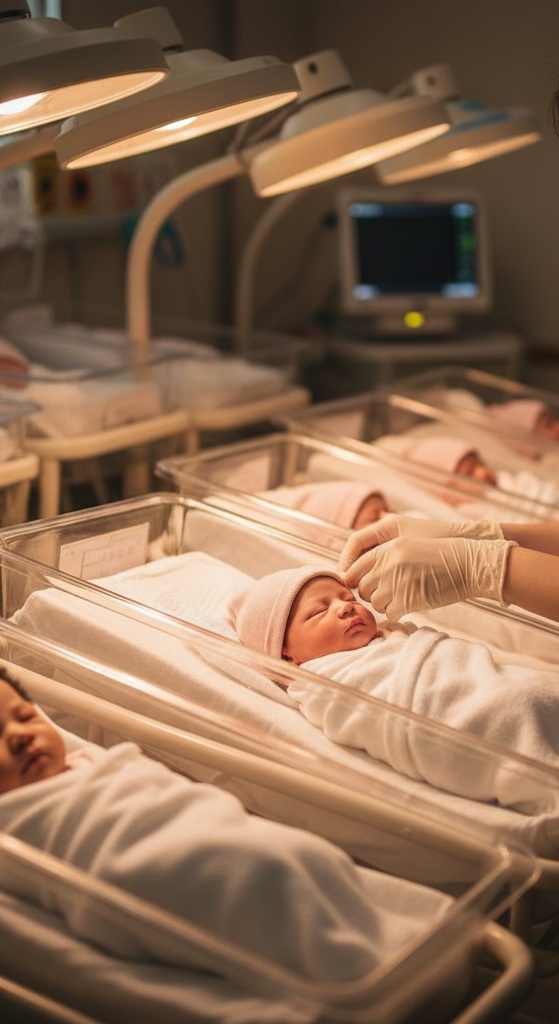
In a recent year, there were 313,752 births in the U.S. to low birth weight babies, while 3,477,960 were to babies with normal weight. Approximate the probability that a newborn baby is low birth weight.
Solution: We compute the number of times the experiment has been repeated:
births.
The proportion of low birth weight babies is
We approximate .
 Definition
Simulation
Sometimes we cannot repeat an experiment enough times to use the Empirical Method.
When that happens, we can use technology to run an equivalent experiment many times instead. Running a virtual experiment this way is called simulation.
Example: Simulation
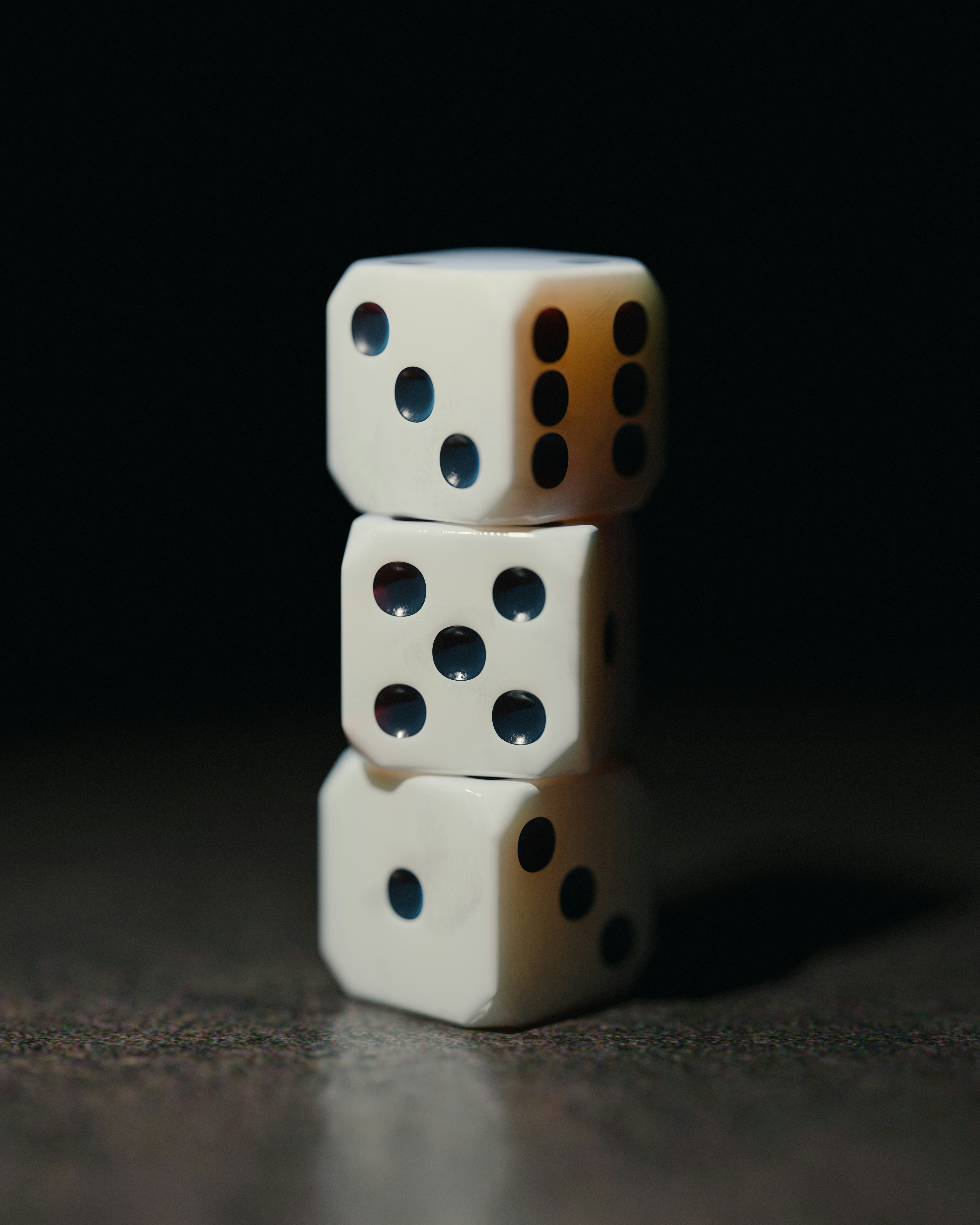
If three dice are rolled, the smallest possible total is 3 and the largest is 18. We will simulate 1000 rolls of three dice to estimate the probability that the total is 10.
Each bar counts how often a total came up. The readouts show how many rolls gave a total of 10; the estimate of is that count divided by the number of rolls.
Roll again runs a fresh set of rolls. The estimate changes every time — it is a sample, not the answer.
Here we can do something the birth weight example could not: we can work out the truth and compare.
Of the 216 equally likely outcomes, 27 give a total of 10, so the exact probability is — the dashed line.
(You are not expected to count these.)
Now drag the number of rolls: few rolls, a jumpy estimate; many rolls, one that settles on the line.
DefinitionUnusual Events
One more idea before we finish, and it is about how we use these numbers.
An unusual event is one that is not likely to happen. In other words, an event whose probability is small. We will use the following rule of thumb.
Any event whose probability is less than 0.05 is considered to be unusual.

Example
About 11% of the U.S. population is left-handed. You randomly select one person and they are left-handed. Is this unusual?
Because 0.11 is greater than 0.05, selecting a left-handed person is not unusual.
In a college of 5000 students, 150 are math majors. A student is selected at random and turns out to be a math major. Is this unusual?
The event of choosing a math major consists of 150 students out of a total of 5000. The probability of choosing a math major is
Because 0.03 is less than 0.05, this would be considered an unusual event.
The Rule of Complements
The last idea in this section is a shortcut you will use constantly.
If is any event, the complement of is the event that does not occur. The complement of is denoted .
According to the Wall Street Journal, 40% of cars sold in a recent year were small cars. What is the probability that a randomly chosen car sold in that year is not a small car?
 Check Your Understanding
Find the complements of the following events.
Two hundred students were enrolled in a Statistics class.
Exactly 50 of them are sophomores.
The complement is that the number of sophomores is not 50.
A movie theater has 150 seats.
Exactly 100 seats are occupied.
The complement is that the number of occupied seats is not 100.
Check Your UnderstandingFind the complements of the following events.
A batch contains 500 manufactured parts.
At least 10 parts are defective.
The complement is that fewer than 10 parts are defective.
A parking garage has 300 spaces.
More than 250 spaces are filled.
The complement is that 250 or fewer spaces are filled.
Check Your UnderstandingFind the complements of the following events.
A Spotify playlist has 50 songs.
Fewer than 20 have been played.
The complement is 20 or more songs have been played.
A warehouse stores inventory in 200 bins.
At most, 25 bins are empty.
The complement is more than 25 bins are empty.
Each time, check whether the boundary number belongs to the statement, and put it on the other side.
 Example
Naming a Complement, Then Finding Its Probability
A rideshare company records 300 rides on a Friday night. The probability that 50 or more of them are surge-priced is 0.35.
What is the probability that at least 50 rides are surge-priced?
“At least 50” is another way of saying “50 or more”, so this is given:
What is the probability that fewer than 50 rides are surge-priced?
“Fewer than 50” is the complement of “50 or more”, so